
Criminal Court Cases in Boone County
Boone County is part of Iowa Judicial District 2B within the Second Judicial District. The Iowa District Court for Boone County is the general-jurisdiction trial court. It hears felony prosecutions, indictable misdemeanors, simple misdemeanors filed as state cases, juvenile matters, and later proceedings tied to those cases. Magistrates conduct initial appearances and handle much of the preliminary and lower-level work that Iowa law assigns to them. Appeals move to Iowa's appellate courts and carry separate appellate records.
The Clerk of District Court at the Boone County Courthouse maintains the court case records. The clerk's file is the right source for a complaint or trial information, docket, judgment, sentencing order, and a certified copy. It is not the same as a jail booking file. City ordinance matters can follow a city process, and the state payment system specifically says city parking fines must be paid to the city clerk. Boone County does not operate a separate municipal criminal court.
Federal criminal cases involving Boone County follow a separate path through the U.S. District Court for the Northern District of Iowa. Search those dockets through PACER; the U.S. Attorney's Office for the Northern District of Iowa publishes federal prosecution information. None of those sources replaces the Iowa District Court docket for a state charge.
Iowa Courts Online for Boone
Iowa Courts Online provides the official statewide electronic docket search. Basic public functions are free. A paid Advanced Case Search subscription adds more party data, judgments and liens, exhibit lists, service returns, financial detail, traffic information, and search tools for case type and schedules. The Judicial Branch's official search help explains the field and access rules. Advanced access does not provide filed document images, which must still be viewed or requested where the case was filed.
The official Iowa Courts Online screen shows how Boone County case records are reached through the statewide system.
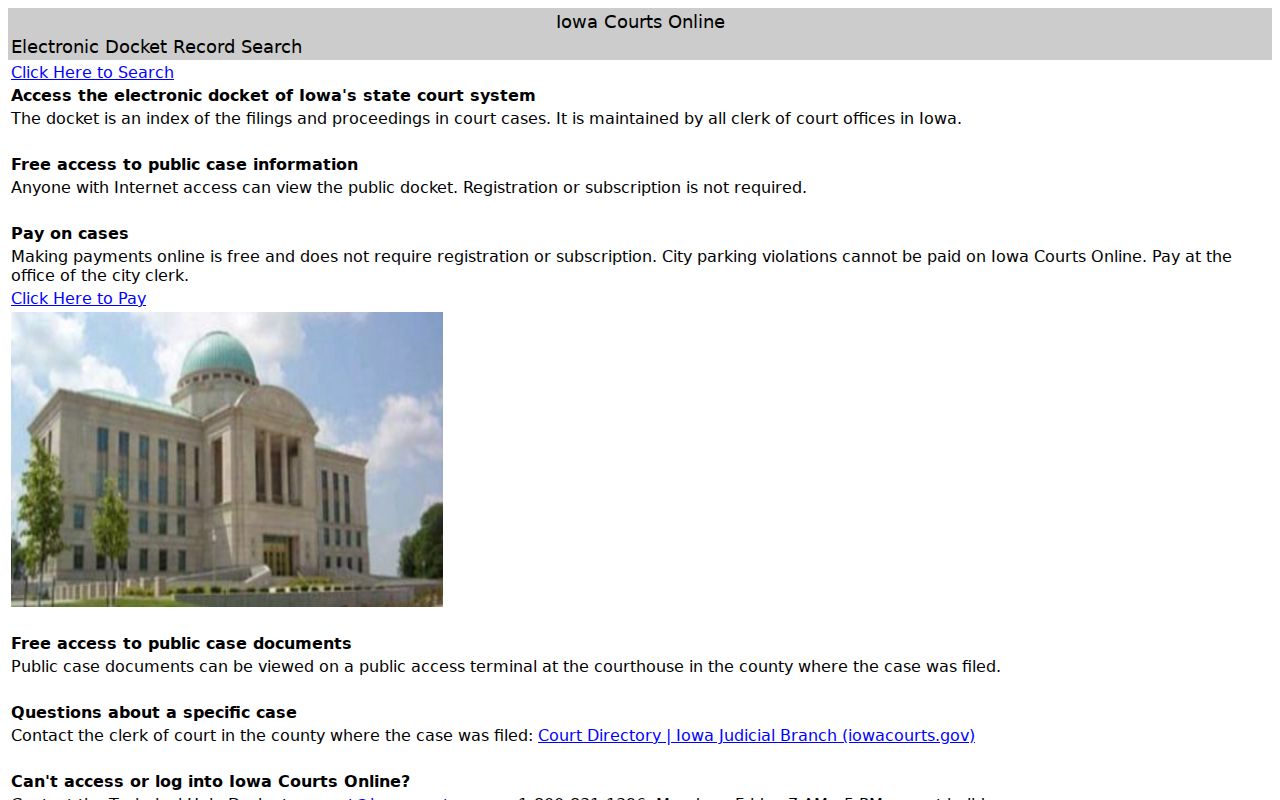
This portal view is a starting point for a docket search, not a substitute for the complaint, judgment, or certified record kept by the Boone County clerk.
Boone County Case Record Searches
A known case ID is the cleanest search key. For a name lookup, Iowa's public locator calls for at least two characters in both the first and last name fields. Select Boone in the county control to keep the result set local. A common name can still bring back several matters, so compare the case ID, type, status, dates, and public party role before drawing any conclusion. Recent citations may need 14 to 21 days to appear.
- Open Iowa Courts Online and choose the public name or case-number search path.
- Enter the full Case ID when known. Otherwise, enter at least two characters of the first and last name.
- Select Boone County and the relevant criminal or traffic case type when the control is available.
- Open the matching Case ID and read the full event history, including the latest disposition-related entry.
- Ask the Clerk of District Court for the public complaint, order, judgment, sentencing record, or certified copy you need.
The search fields below reflect the official free locator and the added search routes described for registered Advanced Search.
| Field Label | Type | Required | Options or Format |
|---|---|---|---|
| By Name | Search path | Choose one path | Uses first and last name |
| By Case or Citation Number | Search path | Choose one path | Uses an exact identifier |
| County | Dropdown | For narrowing | Select Boone for county results |
| First Name | Text | With last name | Enter at least two characters |
| Last Name | Text | With first name | Enter at least two characters |
| Partial Citation Number | Text | Alternative | Enter the last four to six digits |
| Case ID | Text | Alternative | Enter the complete Case ID |
| Case Type | Dropdown | Not specified | Choose the fitting criminal or traffic type |
Note: A recent citation can take 14 to 21 days to appear, after which the Boone County clerk is the official fallback.
Boone County Court Case Identifiers
A Case ID, citation number, and jail booking reference point to different records. Iowa Courts Online recognizes its court identifiers. The Boone County Jail tracks the custody and intake event. A law-enforcement report uses the originating agency's report number. Giving the clerk a booking number alone may not locate the filed case, and giving jail staff a court Case ID may not identify the exact intake record without more context.
| Identifier | Record System | Best Use |
|---|---|---|
| Case ID | Iowa Judicial Branch | Open a specific docket and request the filed court record |
| Citation number | Court payment and case locator | Find a citation after it reaches the state system |
| Booking reference | Boone County Jail | Ask about the local intake, custody, charge, or bond record |
| Agency report number | Arresting or investigating agency | Request the incident or arrest report from its creator |
Start with the number printed on the document in hand, then name the record type when contacting an office. That simple distinction keeps a court-file request from being misrouted to the sheriff or county recorder.
Boone County Clerk Document Access
The criminal-record counter is at the Boone County Courthouse, 201 State Street, Boone, IA 50036. County courthouse hours are Monday through Friday, 8:00 a.m. to 4:30 p.m., except holidays. The public terminal and clerk counter fill the gap when a remote docket lacks document links, a name search is unclear, or an older case needs staff help. Confirm the direct clerk number and any current copy or certification charge through the Iowa Judicial Branch Boone County directory before a visit.
Clerk of District Court
Boone County Courthouse
201 State Street
Boone, IA 50036
Monday-Friday, 8:00 a.m.-4:30 p.m.
The Iowa Judicial Branch court-forms collection helps readers identify approved forms used with court filings.
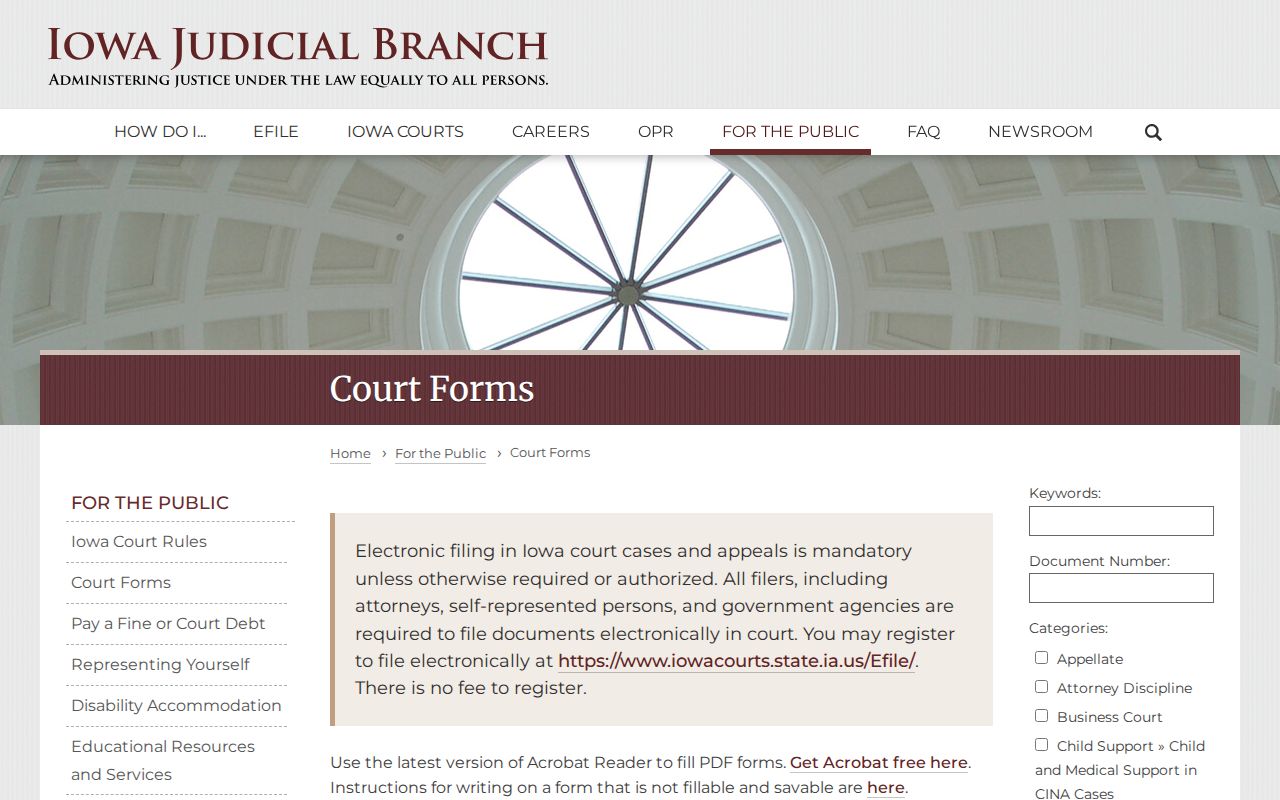
The forms page can identify an approved form, while the Boone County clerk remains the source for a filed case document and its certification. Check the county's current office-hours page for closures before traveling.
What a Criminal Case File Contains
A Boone County case file records the formal prosecution, not just the event that led to an arrest. The file can show how the prosecutor framed each charge, what the court scheduled, how the defendant pleaded, which motions or orders were entered, and how each count ended. A docket entry is an index-level clue. The filed complaint, trial information, judgment, or sentencing order supplies the document-level detail.
| Case Number & Court | The identifier, Boone County venue, case type, caption, and current status. |
|---|---|
| Charging Document | The complaint, trial information, or indictment stating the filed accusation. |
| Docket Entries | Dated events for filings, appearances, pleas, motions, orders, warrants, and later activity. |
| Hearing Dates | Past and scheduled court events, with some schedule functions limited by access level. |
| Disposition & Judgment | The outcome for each charge, such as dismissal, acquittal, deferred judgment, or conviction. |
| Sentence & Conditions | Confinement, probation, fines, restitution, and other court-ordered terms when public. |
Financial entries, service returns, exhibit lists, and related proceedings may also appear. Protected identifiers are not public fields. A court case file must be read count by count because one charge can be dismissed while another ends in judgment.
Note: The filed judgment or disposition order is stronger proof of an outcome than a name-search result or booking description.
Boone County Charging Records
The arresting officer's allegation and the filed court charge are not interchangeable. Boone County Attorney Matthew Speers serves as the county's chief prosecuting attorney. The office reviews and prosecutes state-law violations within Boone County, while city attorneys handle city ordinance violations. The prosecutor can select, amend, or decline charges based on the evidence and Iowa law. That is why a booking description may differ from the complaint or trial information later filed in court.
The Boone County Attorney's office is on the fourth floor of the courthouse at 201 State Street. It does not investigate crimes, represent private persons, or give them legal advice. Crime reports begin with law enforcement. A person seeking appointed counsel submits the required financial application through the clerk; the State Public Defender's published designation assigns Boone County indictable matters to the Nevada Local Public Defender Office.
For electronic filing, the Iowa Judicial Branch maintains the EDMS sign-in system.
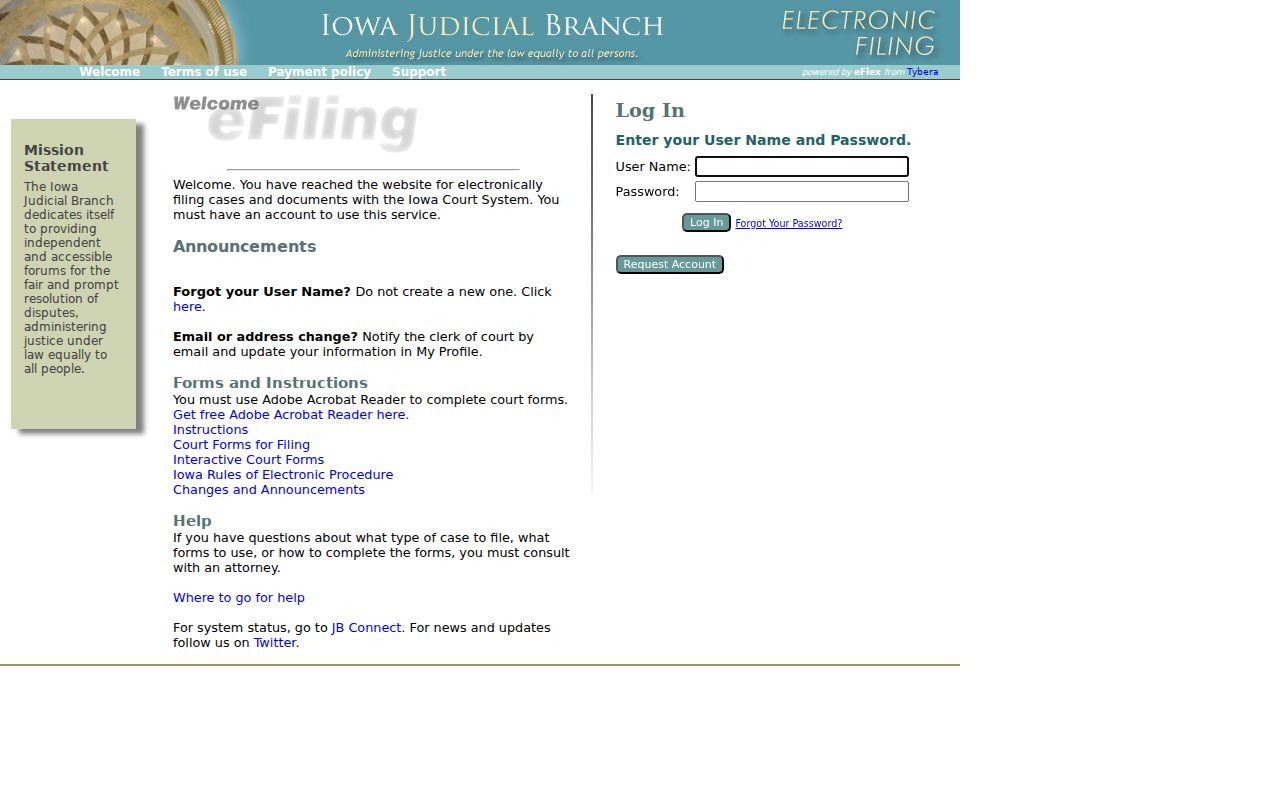
EDMS is a filing channel for authorized users, while Iowa Courts Online and the courthouse counter serve the public record-search path.
Criminal Case Stages in Boone County
A summons or arrest can start the record, but prosecutorial review shapes the filed case. A jailed person on a new charge appears before a magistrate within 24 hours under the Boone County Sheriff's published process, with exact timing set by the judge. The magistrate addresses identity, allegations, counsel, and release or bond. An indictable case then proceeds through a complaint and trial information or indictment, arraignment, discovery, and pretrial motions.
Case flow: Charges Filed → Arraignment → Pretrial → Plea or Trial → Disposition → Sentencing
A dismissal ends a charge without a conviction. An acquittal is a not-guilty ruling after trial. A deferred judgment postpones adjudication and can end without a judgment of guilt after successful completion. A guilty plea or verdict becomes a conviction when followed by judgment. Appeals create another docket, while a later probation violation can return the Boone County case to District Court.
Note: Boone County reports a magistrate appearance within 24 hours for a new-charge arrestee, but the judge sets the exact time.
Reading Boone County Case Status
Portal labels describe different points in a case. “Pending” means the matter has not reached its final outcome. “Disposed” means the court recorded an outcome, but it does not tell you which outcome until you read the charge-level entries. “Dismissed” is not the same as “convicted.” A financial collection entry may be the newest docket event even though an earlier judgment contains the legal disposition.
- Arraignment
- The hearing where the accused is advised of the filed charge and enters a plea.
- Trial information
- An Iowa prosecutor's formal charging document for an indictable offense when the case proceeds without indictment.
- Deferred judgment
- An Iowa procedure that withholds judgment while stated conditions are completed.
- Disposition
- The result of a case or individual charge, including conviction, dismissal, or acquittal.
- Sentence
- The court-ordered consequence after conviction, which may include confinement, probation, fines, or restitution.
When the status wording is unclear, request the judgment or disposition order. That document is stronger evidence of the result than a name-search screen or an old booking entry.
Access Rules for Case Records
Iowa Courts Online offers public docket data, but access depends on the record and the user's access tier. Public terminals may expose links not available in the basic remote view. Advanced Search provides added indexes and details, yet the subscription still does not grant document-image access. Iowa Court Rules chapter 16 govern electronic filing and protection of confidential data. The official Iowa court-rules listings are the source for the current rules.
The Iowa court-rules page shows the statewide framework that applies to Boone County case records.
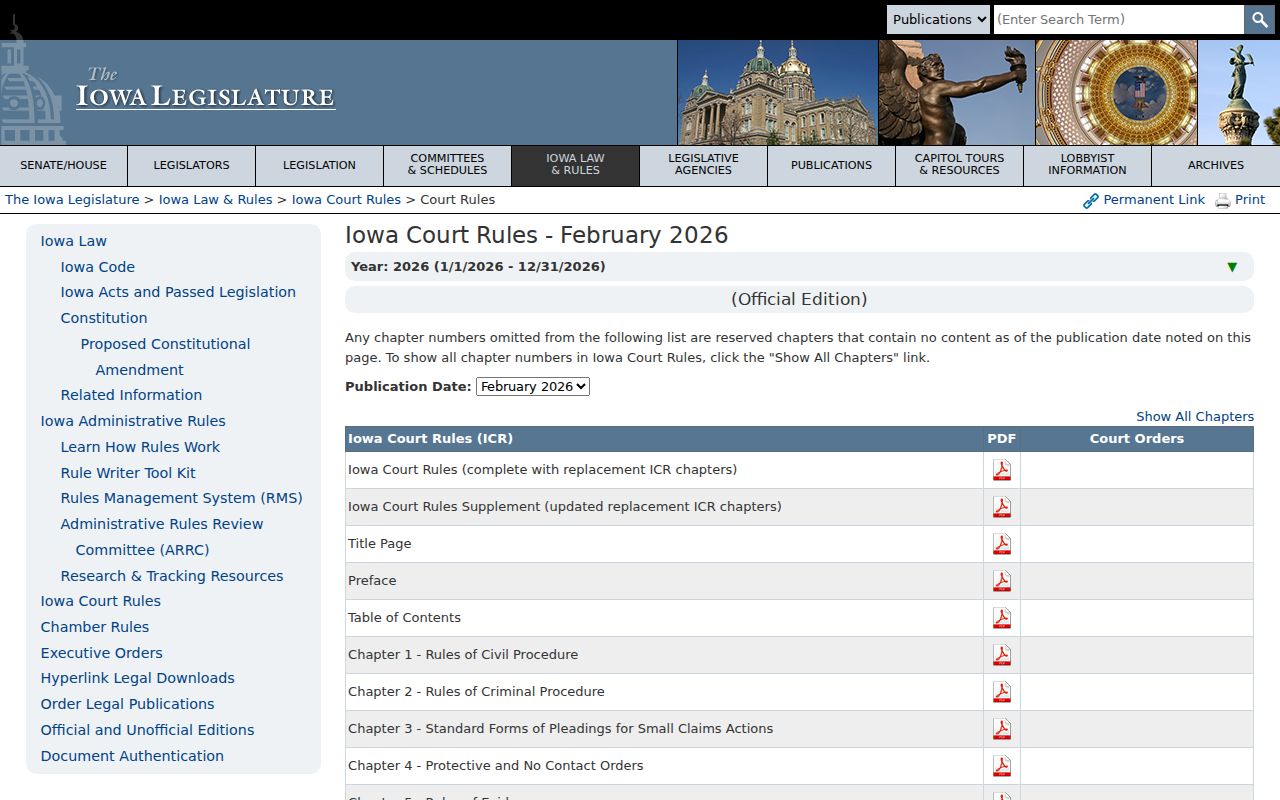
Those rules explain why a public docket can remain visible while confidential filings, private identifiers, or document images are withheld.
Juvenile matters, expunged cases, victim-sensitive content, and protected personal data can be confidential or redacted. A case missing from a public search does not prove that no case ever existed. Check spelling and identifiers, allow the stated posting period for a recent citation, then ask the Boone County clerk whether a public record can be located or inspected. The official Iowa Code title index includes chapter 22, while chapter 692 and court rules supply separate criminal-record limits.