
Boone County Criminal History Checks
Match the question to the record holder before searching. Use Iowa Courts Online for a filed Boone County case and its docket. Ask the Boone County Jail about current custody, charge, or bond details. Contact the arresting agency for its incident report. Request an Iowa DCI check when the goal is a broader Iowa repository response. Each channel reflects a different stage of the justice process, so one empty result cannot rule out information in the others.
Names alone can mislead. Court searches work best with the exact spelling used in the case and a known case number when available. DCI requires a first name, last name, and exact date of birth. A middle name and other lawful identifying details can separate common names. Follow a name match back to the source record before drawing a conclusion.
- Search Iowa Courts Online and limit the county field to Boone.
- Read the case status, charges, filings, and disposition as separate fields.
- Call the jail for a very recent Boone County booking that has not reached the court portal.
- Request the original report from the sheriff, city police department, or Iowa State Patrol that created it.
- Order a DCI record check or a clerk-certified copy when an official source document is needed.
Boone County’s Two Record Counters
Boone County criminal records split between two public buildings. The Boone County Courthouse at 201 State Street is the judicial destination. The Clerk of District Court keeps criminal dockets, filed complaints or trial information, dispositions, judgments, and sentencing orders. The Boone County Law Enforcement Center at 1019 West Mamie Eisenhower Avenue houses the sheriff, dispatch, jail, and booking functions. It is the better first stop for a fresh arrest, current custody, charge, bond, or a sheriff-created report.
The county's own courthouse history shows how long the judicial address has anchored local records. The present building was dedicated in 1918 after the prior courthouse was moved across the street while employees stayed at work inside. Today, electronic docket access and older courthouse records meet at that same location.
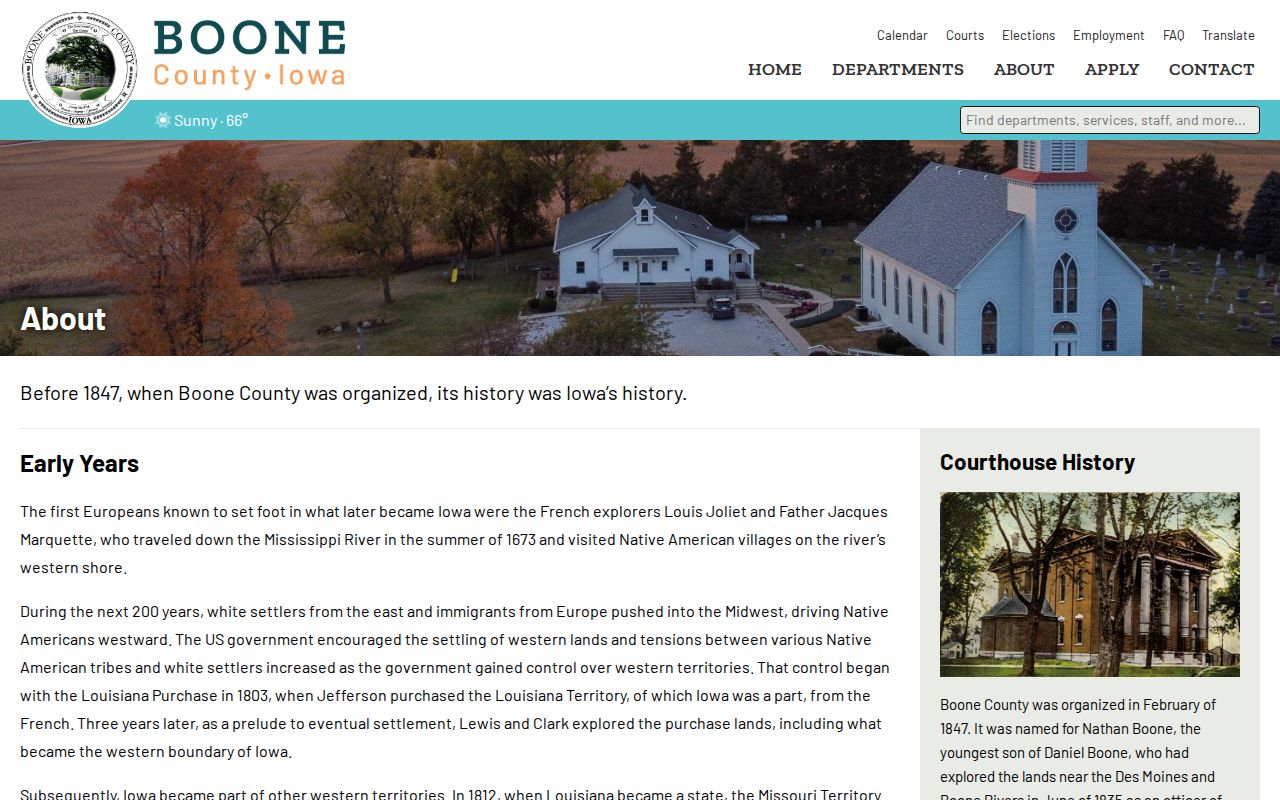
The image captures the official county history source, which is useful context for locating both current and archival Boone County case records.
| Question | Start Here | Record Obtained |
|---|---|---|
| Was a case filed? | Iowa Courts Online or Clerk | Docket and court case details |
| Is someone held now? | Boone County Jail | Current charge, bond, and custody status |
| What did an officer report? | Originating agency | Incident or arrest report, subject to redaction |
| What is in the Iowa repository? | Iowa DCI | Releasable Iowa criminal history |
Note: The county recorder keeps land, vital, and recorded instruments, not Iowa District Court criminal case files.
Official Background Checks in Iowa
The Iowa Department of Public Safety, Division of Criminal Investigation, Records and Identification Section maintains the state repository. Its Iowa Record Check Online route costs $15 for each last name searched. Online, mail, fax, email, and in-person channels are available. Telephone requests are not accepted. A requester must provide the subject's first name, last name, and exact date of birth. DCI advises adding a middle name and other matching details where lawfully available.
A signed release changes what DCI may disclose. Without it, DCI cannot ordinarily release an arrest more than 18 months old when no final disposition is on file, or a successfully discharged deferred judgment. DCI also warns that a “No Iowa Criminal History Found” response may reflect restricted data or confidential juvenile information, not only the complete absence of a record.
The Iowa DCI overview identifies the state unit behind these fingerprint-supported records.
This state source helps distinguish the repository check from a Boone County court search or sheriff report.
| Official Product | Fee Found | Main Limit |
|---|---|---|
| DCI name check | $15 per last name | Iowa repository data, subject to release law |
| Iowa Courts Online basic search | Free basic access | Case docket, not a statewide rap sheet |
| Boone County sheriff report | Some charges may apply | Only the originating agency's record |
| FBI Identity History Summary | Verify current federal fee | Subject-only national fingerprint route |
Boone County Court Record Search
Iowa Courts Online is the official electronic starting point for Boone County criminal court records. A public name search requires at least two letters of the last or firm name. First and middle names can narrow results, and the percent sign acts as a wildcard. Select Boone in the county field to avoid mixing local cases with matters filed elsewhere in Iowa. When a case ID is known, use it instead of relying on a name.
The free view supplies public docket information. Paid Advanced Search adds party detail, schedules, judgments and liens, exhibit lists, service returns, and fuller financial information. It still does not provide public document images. Filed complaints, orders, judgments, and certified copies must be viewed or requested at the courthouse where they were filed.
The Boone County department directory shows which offices share the courthouse and helps prevent a criminal case request from going to the wrong counter.
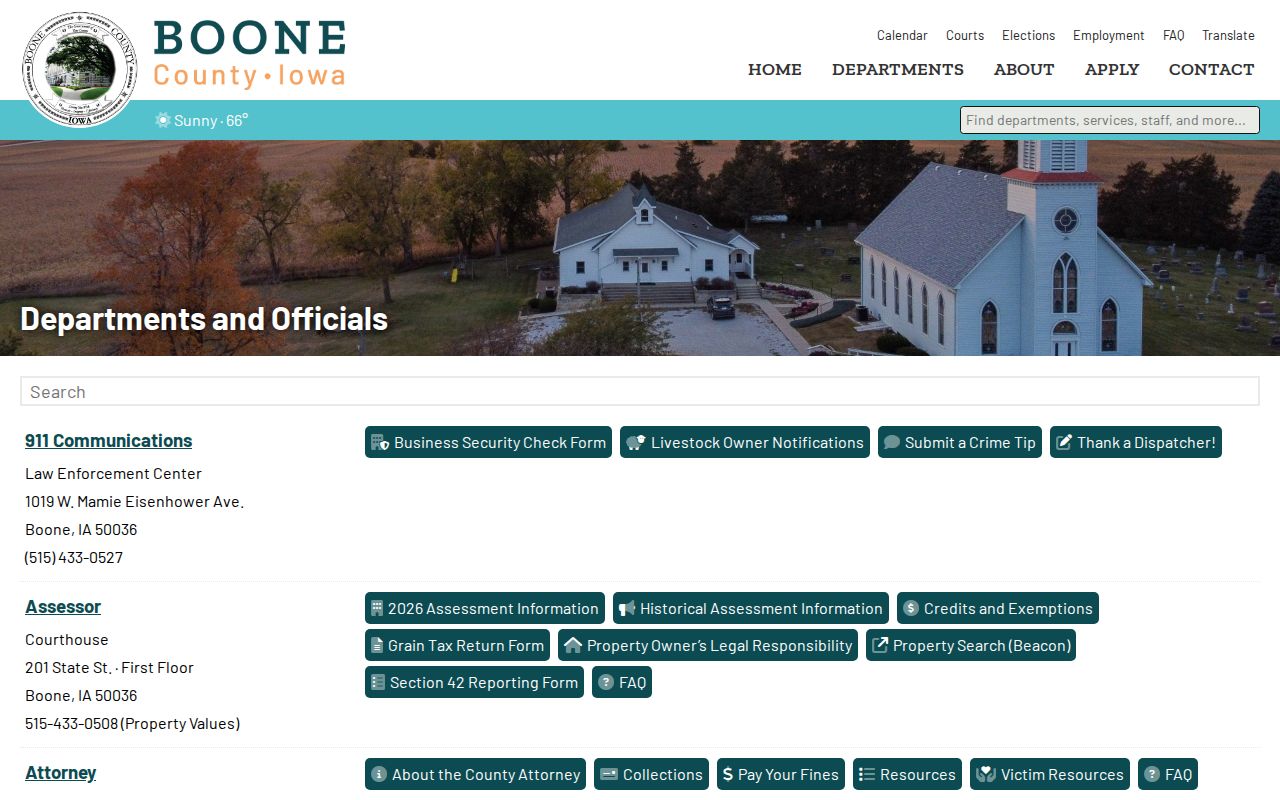
The directory view reinforces the split between elected county offices, the Judicial Branch clerk, and law-enforcement custodians.
Kinds of Criminal Records
A Boone County record search can uncover related files that were created at different times. An incident report begins with the investigating officer. Booking information begins when the jail receives a person. A court file begins when a complaint, trial information, indictment, or citation enters the Judicial Branch system. DCI later joins reportable arrest and disposition events within its fingerprint-supported repository.
- Incident and arrest report: the agency account of an event, with investigative parts subject to Iowa disclosure limits.
- Booking and custody record: jail intake, charge, bond, release, and current-status information.
- Criminal court file: filed charges, hearings, pleas, motions, disposition, sentence, and public financial entries.
- DCI criminal history: releasable state repository data tied to reported Iowa event cycles.
- Corrections or registry record: a separate public system for state custody, supervision, or sex-offender registration.
That separation explains why the same Boone County event can look different across systems. A booking charge may change after county-attorney review. A dismissal may close the court charge without making the original agency report vanish. A current jail roster does not preserve a full arrest history after release.
Iowa classifies felonies as Class A, B, C, or D. Its misdemeanor labels are aggravated, serious, and simple, not first- and second-degree misdemeanor. The filed statute and judgment control the Boone County classification. A booking description is preliminary, and the prosecutor's filed count can differ. Offense-specific penalties, enhancements, and mandatory terms can also change what the broad class label suggests.
Boone County Charge and Bond Records
For a person believed to be in local custody, the most direct official route is 515-433-0524 option 1 or an in-person inquiry at the Law Enforcement Center. The sheriff also links an inmate roster, but the jail's phone and counter route is the stated source for current charge and bond details. Processing volume, a recent transfer, release, or a bond change can make a web roster lag behind the jail's working record.
The Boone County Sheriff page publishes the office and dispatch channels used to route local record questions.
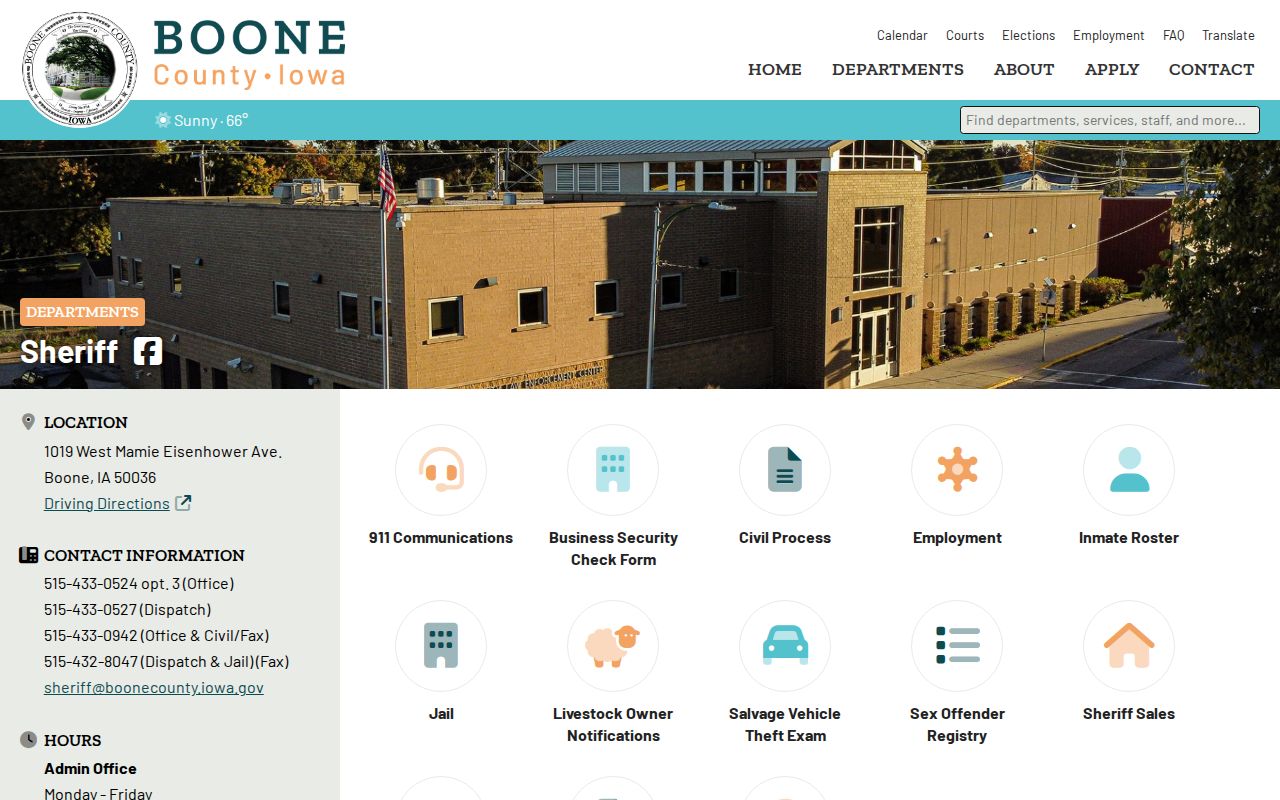
This contact page is the official fallback when a Boone County roster or case search does not answer a time-sensitive custody question.
A new-charge arrestee sees a magistrate within 24 hours, although the judge controls the exact schedule. Boone County lists four release routes: bond, qualifying pretrial release through the Second Judicial District Department of Correctional Services, final appearance and sentencing, or another court order. Bail at the jail may be paid by cash, cashier's check, or money order. For a charge from another county, the cashier's check or money order must name that county's clerk as payee.
Boone County Criminal Records: What They Contain
Iowa Code chapter 692 supplies the core vocabulary for a state criminal history. Arrest data can include the charge and the arrest date, time, and place. Conviction data identifies a conviction or guilty plea and its court. Disposition data records the outcome. Correctional data concerns public status and location information within sheriff, corrections, or parole systems. A local case file offers more detail about filings and hearings than a repository response.
| Name & Identifiers | Names, aliases, birth information, and other lawful matching data vary by system. |
|---|---|
| Arrest / Booking Data | Arrest and intake times, agency, booking event, charge, bond, custody, and release fields. |
| Charges & Statutes | Officer allegations, prosecutor-filed counts, Iowa code sections, and offense class may differ by stage. |
| Disposition | Pending, dismissed, acquitted, deferred, or convicted outcomes must be read count by count. |
| Sentence | Confinement, probation, fines, restitution, and other filed court conditions where public. |
| Custody / Supervision | County jail status, Iowa DOC custody, probation, or parole information comes from distinct custodians. |
- Disposition
- The recorded outcome of a case or individual charge.
- Deferred judgment
- An Iowa procedure that withholds judgment while conditions are completed.
- Rap sheet
- An event-based repository response linking releasable arrest, disposition, and correctional submissions.
- Bench warrant
- A judicial warrant often tied to a missed appearance or failure to comply with a court direction.
Read the fields as a timeline. Arrest, booking, filing, disposition, and sentence dates can differ. The final court entry controls the case outcome, while the present custodian controls current custody status.
How Boone County Bookings Reach DCI Records
A Boone County arrest starts several records, not one master file. The arresting officer creates the agency report. Jail staff create intake and custody entries at the Law Enforcement Center. Fingerprints connect a qualifying arrest event to the correct identity in DCI's biometric system. The court separately records charges, hearings, pleas, disposition, and sentence. Iowa law directs disposition reporting so the state event can be updated after the case ends.
Record flow: Arresting agency › Boone County booking › fingerprints to DCI › Iowa District Court case › disposition reporting › updated state history.
A missing disposition, a common-name match, a recent filing delay, or an event outside Iowa can make one source incomplete. Compare the court outcome with the DCI event when reviewing your own record. If they conflict, use the clerk for the judicial file and DCI's challenge process for the repository entry.
The official Boone County government homepage provides the current county gateway used to confirm office notices and closures.
That local gateway should be checked before a courthouse or Law Enforcement Center visit, especially around county holidays.
Iowa Public Access Laws
The Iowa Open Records Law, Iowa Code chapter 22, starts from a right to inspect and copy public records unless another law makes the material confidential. A custodian may charge reasonable costs and may redact protected portions. Peace-officer investigative reports can be confidential, while limited immediate facts about an incident generally remain available unless disclosure would plainly and seriously jeopardize an investigation or create a clear safety danger.
Key Iowa authorities:
Chapter 22 grants public-record access, permits reasonable fees, and lists confidential categories.
Chapter 692 controls criminal-history definitions, dissemination, challenge rights, and reporting.
Chapter 232 applies special access rules to juvenile court and justice records.
Chapter 901C sets Iowa's outcome-specific expungement rules.
The Iowa Public Information Board is the state's open-government advice and enforcement resource. Boone County links its Open Records Request Form from the county policies and forms page. A focused request should name the likely custodian, record type, incident date or date range, location, and desired delivery method. Ask for a cost estimate when retrieval or redaction could be substantial. A chapter 22 request cannot override a law that protects juvenile, victim, medical, intelligence, or active-investigation material.
Resolving Boone County Warrant Records
Boone County does not publish an official countywide active-warrant search. That makes the fallback chain important. Search the Boone County court docket for public entries such as a warrant issuance, failure to appear, service, or recall. Then verify operational status with the Boone County Sheriff or dispatch. The clerk can explain the public docket and provide public orders, but court staff cannot promise that a law-enforcement system has already cleared the warrant.
When a warrant may be active, confirm the case number and issuing court before taking action. A missed appearance, new-charge warrant, or supervision violation can require different steps. Paying an unrelated balance does not clear a judicial order. After a court recalls or returns a warrant, obtain the docket entry and verify that the sheriff's operational record reflects the change.
Note: A stale commercial list is not a safe source for deciding whether a Boone County warrant remains active.
Restricted, Sealed & Expunged Records
Iowa uses several narrow, outcome-specific forms of expungement. A qualifying acquittal or dismissal follows Iowa Code section 901C.2. Section 901C.3 permits a one-time expungement of certain misdemeanor convictions after more than eight years when all statutory conditions are met. The applicant must have no pending charges, must satisfy financial obligations, must remain within the deferred-judgment limit, and must not have an excluded offense. The offense section in the judgment matters more than a short portal label.
A successfully discharged deferred judgment is not the same as a conviction. Court-record treatment follows chapter 907 and the applicable expungement rules. DCI explains that its event may remain but is updated to show a discharge and nonconviction status, with release restricted without authorization. Juvenile records, protected identifiers, victim details, and confidential investigative material follow separate rules.
Start any Boone County expungement review with the actual court disposition. Use the current Iowa Judicial Branch form, file through the Clerk of District Court that holds the case, and later verify both the court view and your own DCI record. A court order, a repository update, and removal of private copies are different processes.
Boone County Jail and Prison Records
The Boone County inmate roster covers current local custody. It is not the right tool for a person who has moved into state prison or community supervision. The Iowa Offender Search covers Iowa Department of Corrections custody and supervision. Federal custody uses the Bureau of Prisons locator. VINELink can supplement official custody notification, but it does not replace the jail, court docket, or repository record.
The Iowa Department of Corrections page provides the state-level route after a person leaves Boone County pretrial custody.
The state correctional layer should be checked only after distinguishing local booking status from a later sentence or supervision order.
Probation and parole in Boone County are state-run through the Second Judicial District and Iowa DOC, not a county probation department. The court file shows the legal sentence and revocation orders. The supervising office holds operational material, much of which is not public. Absence from the jail roster alone does not reveal whether a person was released, transferred, sentenced, or never held there.
Correcting Boone County Record Errors
First identify which source is wrong. An arresting agency controls its report. Boone County Jail controls booking and custody fields. The Clerk of District Court controls the court docket and filed orders. DCI controls the state criminal-history compilation. Sending a court disposition to the sheriff does not authorize the sheriff to edit DCI, and asking the clerk to change a police narrative sends the issue to the wrong custodian.
For a mistaken name match, compare the case number, exact date of birth where lawfully available, court, charge date, and disposition. For a missing or wrong court outcome, obtain the filed judgment or order from the clerk. Then use DCI's accuracy challenge route for the repository entry. DCI may request fingerprints to resolve identity. Keep copies of the source document and the response from each office so later checks can be compared.
Note: An arrest without a disposition is not proof of guilt, and Iowa law requires that warning with released criminal-history data.
City-by-City Criminal Records in Boone County
Boone, Madrid, and Ogden create city police or public-safety records, while Boone County Jail handles county booking and Iowa District Court holds filed criminal cases. Iowa has no separate municipal court system, so a city citation or arrest can lead to a Boone County court file even though the original incident report stays with the city agency. These city record checks focus on the local police route, after-hours contact, and publication tools that differ by community.
Boone Record Check
12,460 residents in 2020 · Police records begin at 525 Story Street, with county dispatch after hours.
Madrid Record Check
2,802 residents in 2020 · The combined Public Safety Department routes Madrid police record requests.
Ogden Record Check
2,007 residents in 2020 · Ogden publishes a distinctive weekly police report archive.
City boundaries also affect the report custodian. A stop on U.S. 30 or Iowa Highway 17 may involve a city officer, a Boone County deputy, or Iowa State Patrol. Confirm the agency shown on the citation, jail entry, or case docket before sending a request.